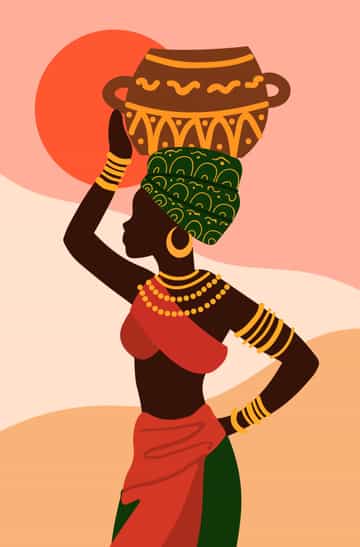
The Manifesto of
African Privilege.
A creed for the continent, the diaspora, and the aligned. Read it slowly. Return to it often. Live from it.
This is not a call to arms. It is a call to attention.
Africa does not need to be defended. She does not need to be proven. She does not need to be rescued, ranked, or explained to those who have spent generations refusing to see her. She is, and she was, and she shall be, and the grammar of her existence does not require translation into any other language to be real.
What the continent asks of us now is simpler and harder than defense. She asks that we notice. That we attune. That we stop outsourcing the interpretation of who we are to peoples who cannot see us. That we begin to create from where we stand, with what we carry, for what is ours to build. She asks that we claim the privilege of being from her, which is to say, the privilege of being at all, since every human being alive is a child of her soil if you trace the line back far enough. We are simply the ones who stayed, or who return, or who have begun to remember.
This manifesto is a creed. Not a theory to be debated, though theory lives inside it. Not a movement to be joined, though movements may grow from it. A creed is something you stand on. Something you return to when the week has beaten you and the continent feels like a burden and you have forgotten why you chose this soil. A creed is something you say aloud in the morning so that by evening your hands remember what your mind committed to.
It is written to the collective African. To those born on the continent and those born out of her who still feel her pull. To founders and farmers, poets and politicians, mothers and mystics, engineers and elders, the unemployed and the overworked, the certain and the quietly unsure. It is also written to any single one of you, alone, reading late at night, wondering whether your particular life matters to the larger story. It does. That is partly what this creed is for. To remind you.
The claim at the heart of this document is unusual, and you should understand it before you go further. African Privilege is not a claim about human beings. It is a claim about the continent herself. Africa is alive. She is a being, not a place. She holds a creative inheritance that precedes every person walking on her and will outlast every person alive today. What we call privilege is participation in what she holds. The privilege is hers. The gift to us is that we are invited to take part.
This reframes everything. It means the question is not whether you are African enough. The question is whether you are participating. It means the inheritance is not yours to possess. It is yours to flow through. It means colonialism did not steal the privilege, because the privilege was never storable; it could only ever be lived. And it means the continent's rising is not conditional on the world's permission. She will rise irregardless, because her rising is simply her being what she has always been, fully, finally, without apology. The only question is whether you will rise with her.
What follows are seven pillars. Each names a gift and the obligation that rides with it, because no African tradition has ever separated blessing from duty. Take them slowly. They are not meant to be finished. They are meant to be lived.
Pillar One
The Continent is Alive
Africa is not a stage. She is a subject. She does not contain our story; she is telling it.
Every other identity philosophy begins with a people. This one begins with a place. Or rather, it refuses the split between place and person that the modern world has taken for granted. The Akan knew that land holds sunsum, spirit. The Yoruba did not distinguish between the river and Oshun. The Kikuyu did not look at Mount Kenya and see only stone; they saw Mũgai dwelling. The Dogon did not tend the earth; they understood that the earth tended them. Across the continent, in a thousand tongues, the same knowledge: the land is alive, and the human being is a participant in a larger aliveness that does not require human beings to exist.
This is not mysticism dressed up for an audience. It is the oldest and most empirically sound position available to a human being.
A person who listens to land does not destroy the land that feeds them. The civilizations that forgot this have spent two centuries producing an unlivable planet and still cannot understand why. Africa has not forgotten, though parts of her have been made to forget, and parts of her forgot on their own, and the forgetting is always followed by a reckoning.
To hold this pillar is to accept that the continent has her own intelligence. She has her rhythms, her seasons, her languages, her griefs, her joys, her intentions. She is not neutral about what we build on her. A road that serves extraction is not the same as a road that serves connection, and the land feels the difference even when the engineer does not. A city that refuses her rivers will be punished by her rivers. A crop that exhausts her will exhaust those who eat it. The continent rewards attunement and punishes arrogance, not by divine decree but by the ordinary physics of a living system.
The Gift
The gift of this pillar is that you are never alone on African soil. The land is with you. The ancestors are in the soil. The future generations are already whispering from the soil that will hold their feet. You walk on family when you walk on this continent, and family is not something you leave behind when you fly out; it is something that travels with you because you were made of it. Carry that. It will steady you.
The Obligation
The obligation is attunement. Read the land. Learn her signs. When you build, build with her, not against her. When you consume, consume what she offers in season, not what the global market has taught you to crave. When you raise children, raise them in relationship with her, not estranged. Plant something. Tend it. Let something you did not plant grow wild. Know the names of at least three trees near where you live. Know which way the rain comes. Know where the water table sits. This is not nostalgia; it is the baseline competence of a person living on a living continent. A founder who does not know the land he is building on is not a founder. He is a passenger.
Pillar Two
Co-creation is Triune
You were not made to create alone. You were made to create with the Source, with community, and with the land. Any creation that severs these threads is not creation; it is theft.
The Western story of creation has a single figure at its center. The lone genius. The self-made man. The founder who built it himself. It is a lie that the world has paid for in currencies of loneliness, ecological ruin, and the hollow success of people who got everything they wanted and found no one to share it with.
The African story is triune. You create with the Source, whom different traditions name differently and whom no single tradition contains. You create with community, who came before you and who will come after, and without whom you would not be a person at all. You create with the land, who is not your raw material but your partner. Break any of these three and the creation that results will be shaped by the absence. It will be beautiful and broken. Rich and unwell. Celebrated and secretly hollow.
The Yoruba have a word, ase, often translated as "the power to cause change, to make things happen." Ase is not a solo possession. It flows, and it flows through relationship. You do not generate ase from yourself; you participate in it, and the degree of your participation is a function of how aligned you are with what is larger than you.
The most powerful human being, by this grammar, is not the most assertive. It is the most aligned.
The Kemetic concept of Ma'at, truth and cosmic balance, makes a similar demand. A life of Ma'at is a life in right relationship. The Akan speak of Nyame, the Supreme, not as distant sovereign but as the source of sunsum, the spirit-stuff that runs through all being. The Bantu family of languages gathers this knowing into ntu, the creative force that animates all that is. None of these traditions imagines the creator as separate from creation. The creator is immanent, participating, relational.
This pillar asks you to reshape how you work, how you partner, how you rest, how you worship. It means you cannot build in secret and expect the building to stand. It means your ventures must include community at their origin, not as beneficiaries added at the end. It means your success is not measured only by what you achieved but by what you tended. It means prayer, or meditation, or silence, or whatever name your tradition gives to the practice of contact with the Source, is not optional. It is structural. Sever the line to the Source and the most your effort can produce is clever machinery. Sever the line to community and you will build monuments to yourself that no one mourns. Sever the line to land and you will extract until there is nothing left.
The Gift
The gift is that you are never the only one working. The Source collaborates. Community carries you on days you cannot carry yourself. The land rises to meet you when you align with her. You are outnumbered, in the best possible way. There is always more working with you than you can see.
The Obligation
The obligation is to tend all three, daily. Morning practice toward the Source, whatever form it takes for you. Regular, non-transactional time with community, including people who cannot do anything for you. Hands in soil, feet on ground, breath with the weather. A life of co-creation is a life of relational maintenance. Those who treat relationship as overhead to be minimized have already misunderstood what being is.
Pillar Three
The Inheritance is Vast
What you carry did not begin with your parents, did not begin with colonialism, and does not end with your mortality. The inheritance is older and larger than any single life can exhaust.
A great distortion of the modern African imagination is the belief that our story begins in 1884, at the Berlin Conference, or in 1885 with the start of the Scramble. Or perhaps in 1957 with Ghana's independence. Or 1994 with South Africa's. Colonialism was a terrible thing, and we will speak of it honestly in a moment, but first we must refuse to let it organize our sense of time. The African story does not begin with European arrival, and it does not end with European departure. The European chapter is a chapter. One among many. A hard one. Not the frame.
The inheritance runs deeper than almost any other on earth. Consider a few stones in the foundation. The Ishango bone, found in what is now the Democratic Republic of Congo, is more than twenty thousand years old, and its markings suggest mathematical operations our ancestors were performing while much of the rest of the world was still inventing the wheel. The Aksumites of what is now Ethiopia developed Ge'ez, an indigenous writing system from which modern Ethiopian scripts descend, and their civilization was among the four great powers of its age, alongside Rome, Persia, and China. The scholars of Timbuktu at Sankore were producing and preserving manuscripts when much of Europe was still pre-literate. Ironworking in sub-Saharan Africa developed independently, using tall furnaces with convectional airflow, an innovation without parallel elsewhere. The trans-Saharan trade routes moved gold, salt, jurisprudence, and scholarship across a distance greater than the width of the Mediterranean. The Bantu expansion carried agriculture and metallurgy across a continent and seeded the roots of some five hundred modern languages.
And those are just a handful from the deep past. The inheritance also contains the social technologies that the modern world is still rediscovering. Chamas in East Africa, susu in West Africa, stokvels in South Africa, equub in Ethiopia: rotating savings and credit associations that predate "microfinance" by centuries and still move billions annually. The NwaBoi (also called Igba Boi) apprenticeship system of the Igbo: an equity-and-succession model that produces more founders per capita than any formal accelerator in the world. Harambee in Kenya: collective pooling as civic infrastructure. Ujamaa in Tanzania: Nyerere's attempt to scale familyhood into political economy. Gacaca in Rwanda: a restorative justice mechanism that processed post-genocide reconciliation at a scale no Western court system could have absorbed. The Truth and Reconciliation Commission of South Africa, which became a global template.
And the inheritance is still being written. M-Pesa in Kenya turned the basic mobile phone into a financial system and leapfrogged a banking infrastructure that never would have reached the unbanked. Zipline's medical drones delivered blood to rural Rwanda before they operated anywhere in the West. Nollywood built the world's second-largest film industry by volume on a model the traditional studios are now studying. Afrobeats, Amapiano, and Afro-fusion have moved from regional sounds to defining global pop in under a decade. Ethiopian Airlines runs profitably and reliably across a continent that carriers from richer economies have repeatedly failed to serve. This is not a handful of exceptions. It is a pattern, and the pattern is older than the modern period.
Now, the colonial chapter. It is real. It cost us generations of life, of stolen labor, of extracted wealth, of suppressed languages, of psychological damage we are still undoing. To speak of the inheritance without acknowledging this would be dishonest. But to let this chapter become the frame of our story would be a second kind of dishonesty, and a deeper one.
Because the frame gives the colonizer the final word. It says that whatever Africa was before is defined by what Europe did to her. It is not. She is not. The wound is real. The wound is not the frame.
The Gift
The gift of this pillar is the sheer scale of what you have to draw from. You are not a poor heir. You are a rich heir who has been told he is poor for so long that he has forgotten to open the trunks in his own house. Open them. Study them. The inheritance contains genius answers to problems the world is still asking, and your contribution will be stronger for standing on what was already built.
The Obligation
The obligation is to know your inheritance. Actually know it, not gesture toward it. Read African history; there is more of it than you have time for. Learn the pre-colonial systems of your region. Know the names of at least ten African thinkers you can cite by argument. Teach your children or your nieces or the young people in your care what Africa was, what she is, what she has built. Every African who does not know his own inheritance is a resource wasted, and the continent cannot afford to waste us.
Pillar Four
Community Completes the Self
You are not an individual who belongs to a community. You are a community that has taken the form of an individual.
The most famous statement of this pillar is Bantu: umuntu ngumuntu ngabantu, a person is a person through other persons. It is often translated as "I am because we are." That translation is correct but flattened. The deeper claim is not that community is an add-on to a pre-existing self. The claim is that the self does not pre-exist community. You do not exist first and then encounter community. Community is the condition for you existing as a self at all. Break the community and you do not become a more free individual; you become a less complete person.
This is the single most misunderstood claim in African philosophy when it travels to the West, because Western thought carries Descartes' cogito in its bones. "I think, therefore I am." A self that begins alone in a room. African philosophy has a different opening move. The Zimbabwean philosopher Pobee once rendered it as cognatus ergo sum: I am related, therefore I am. You exist because others made you, feed you, teach you, mirror you, correct you, receive what you make, and hand it forward. Remove them and the "I" that remains is not more authentic; it is impoverished.
An economics that rewards individual accumulation at the cost of community connection is not efficient; it is cannibalistic.
A technology that atomizes people into isolated consumers is not progress; it is a regression into an earlier, lonelier form of life. A career path that requires you to leave your people behind in order to rise is not ambition; it is amputation. And the communal practices African traditions have carried, the shared meals, the extended families, the obligations to kin, the rituals that bring generations together, are not cultural quirks to be left behind as we modernize. They are load-bearing architecture.
This does not mean the individual is erased. A common distortion of African communalism is to imagine that it swallows the person. It does not. Igbo philosophy carries the concept of chi, the personal guardian spirit, the particular destiny of a single life. Yoruba thought speaks of ori, the individual's inner head or destiny. African traditions have always known that each person is singular, irreplaceable, the subject of a specific calling. What they refuse is the idea that this singular calling can be realized alone. Your chi and my chi are distinct, but they are completed by meeting. Your ori is yours, but it is shaped in relation.
The Gift
The gift of this pillar is that you are already held. You are not on your own. Community is not something you have to earn your way into. You were born into one, and if you have been severed from it, another is available to you because African community is not a closed club. The chamas will take a new member. The church will add a chair. The elders will answer a young person's question. The diaspora WhatsApp group will absorb a new joiner. You are less alone than you think.
The Obligation
The obligation is bidirectional. Receive what community gives, and give back what your particular life was made to offer. Show up at funerals and weddings, not only when it is convenient. Remember names. Send money home, and also send time, and also send presence. Do not allow the pressures of modern life to turn you into a person whose relationships are maintained only by notifications. Visit the old people. They are leaving. Every African elder is a library, and when one goes unvisited, something irreplaceable burns. Teach the young. They are arriving. Your niece, your nephew, the apprentice at work, the kid on your street who sees you as someone worth copying. You owe them the self you became. Show them how it was done, and also show them where you fell short, so that they can build past your limits.
Pillar Five
To Make is to Worship
The creative act is not a private hobby. It is how the continent speaks through you. What you make is liturgy whether you call it that or not.
There is a reason Africa produces more music, more stories, more dance, more sartorial genius, more cuisine, more visual languages than the global cultural economy knows how to absorb. The continent is generative. It is her nature. And because creation is our inheritance, to make is not merely to work; it is to participate in what the continent is already doing through millions of hands, tongues, bodies, and businesses at any given moment. Every Afrobeats track, every startup launch, every crop planted, every meal cooked with intention, every poem written, every market stall opened, every code repository pushed, every textile dyed, every child named: these are the continent speaking through her participants. The scale is vast because the source is vast.
This pillar reshapes the meaning of work. In a framework where work is what you do to earn a living, most of it is drudgery and the only question is how to minimize it. In a framework where work is how you participate in co-creation, every hour at the craft becomes consequential. The spreadsheet you build, if it serves the continent's rising, is part of the same liturgy as the song. The logistics system that actually delivers on time is part of the same liturgy as the poem. The founder who ships a product that works is doing what the poet is doing, in a different key. All of it is the continent speaking.
This does not flatten into "all work is holy therefore any work will do." The opposite. The framing raises the stakes. If your work is participation in something larger than you, then shoddy work is not merely unprofessional; it is unfaithful. If your venture extracts from the community that raised you without returning, it is not neutral; it is a betrayal of the gift that made you capable of building in the first place. If your art is a performance of your own cleverness without carrying anything the continent needs carried, it is pretty, and pretty is not enough.
You build a stage where you are, and the world comes to you, or it doesn't, and either way you have built something real.
Nollywood understood this early. The founders of that industry did not wait for Western studios to validate them, did not chase Western production budgets, did not try to look like Hollywood. They built a model that fit the continent: low-cost, high-volume, rapid iteration, stories that African audiences actually wanted. They served their own people first. The world followed. Afrobeats did the same. So did M-Pesa. So did the chamas, centuries before any of them. The pattern is clear. You build for the continent first, in the form the continent actually wears, with the resources actually available, and the excellence of the building earns its global reception. You do not beg your way onto the global stage.
The Gift
The gift of this pillar is that your work matters. Not in the self-help sense. In the cosmic sense. What you make is part of what the continent is making through her people right now, and it counts, whether the global press notices or not. Even the unseen work. The teacher in the rural school. The mother who taught her daughter to read. The mechanic who kept the matatu running for another year. The nurse who stayed when it would have been easier to leave. The farmer feeding a city that does not know her name. The continent keeps her ledger. Every act of true making is recorded in her memory.
The Obligation
The obligation is to make well. Make with excellence, even when no one is watching. Make from Africa, not in imitation of elsewhere. Make what your specific life was positioned to make, not what someone else would make better. Make for your community first and the world will find you. Ship. Most people who call themselves creators do not ship; they consume the idea of creation while producing little. Do not be one of these. A manuscript finished in obscurity is worth more than a thousand brilliant plans unexecuted. And when you fail, which you will, fail publicly, learn publicly, and try again. The continent needs builders, not performers.
Pillar Six
Sovereign in Mind
You do not need the West's permission to exist, its frame to think in, or its validation to succeed. Take what serves. Leave what does not. Never again hand your mind to someone else to run.
The hardest colonization to end is the one inside the head. Political independence came to most African countries between 1957 and 1980. Economic independence is in progress, unevenly, a long contest. Mental sovereignty is the deepest layer and the one each generation has to win for itself because it cannot be inherited; it has to be claimed. This pillar is about claiming it.
The Kenyan writer Ngũgĩ wa Thiong'o titled his great book Decolonising the Mind, and the title carries the whole argument. The African mind, for a long season, has been trained to run on borrowed software. To see itself through the eyes of the colonizer. To rank its own productions against a reference frame it did not design. To celebrate itself in phrases like "the African Silicon Valley" or "the Harvard of Africa," which sound complimentary but are quietly humiliating, because they define the continent's achievements by their resemblance to someone else's.
Sovereign in mind means this stops. It does not mean rejecting the West. The West has produced things of real value. The scientific method is a powerful tool. Contractual capitalism, properly bounded, coordinates human effort at scale. Constitutional democracy, where it has worked, has distributed power in humanizing ways. Take them. Use them. You are not required to refuse what is useful because of who made it, and that refusal would itself be a kind of dependence, a prideful subservience dressed up as resistance.
The sovereign mind is absorptive. It eats from the whole human table without anxiety and without apology.
What the sovereign mind refuses is the hierarchy that says Western knowledge is default and African knowledge is exotic. That scientific method is rigorous and indigenous knowledge is folk. That English is universal and Yoruba is local. That Harvard is the standard and the University of Ibadan is the aspiration. These rankings are not descriptions of reality. They are residues of a period when power dictated taxonomy. The power is ending. The taxonomy should end with it.
This pillar has everyday applications. Cite African thinkers first in your work. If you are writing about philosophy, you can quote Mbembe before Foucault. If you are writing about economics, you can reference Sarr or Ayittey before Friedman. If you are writing about justice, you can cite Ramose, Tutu, or wa Mutua alongside Rawls. This is not nationalism; it is epistemic sovereignty. You are writing from where you stand, and where you stand has a library. Read it.
Speak your languages where you can. Even imperfectly. The languages carry concepts the European languages cannot hold cleanly. Igbo, Yoruba, Swahili, Amharic, Zulu, Wolof, Hausa, Kikuyu, Shona, Luganda, Kinyarwanda, Tamazight, Kiswahili again, because it bears mention twice. Every language kept alive keeps alive a way of seeing. Every language lost is a dialect of human possibility extinguished.
Build reference frames that fit your work. If your startup's metrics matter in your context, use those metrics. Do not translate your business into KPIs that were designed for Palo Alto. If your art form has its own vocabulary, use it, and if the global press needs a glossary, let them build one. You are not the visitor to their world. They are visiting yours.
The Gift
The gift of this pillar is freedom. Actual freedom. Not the negative freedom of no one stopping you, but the positive freedom of standing somewhere and looking out from there rather than always looking in. A person who thinks in his own language in his own frame from his own ground cannot be humiliated by rankings designed elsewhere. He is unreachable by that particular species of wound. This freedom is rare, and the few who carry it tend to produce the most durable work because their motivation is not recognition.
The Obligation
The obligation is the daily labor of sovereignty. Decolonize the bookshelf. Examine the assumptions you picked up at school. Notice when you are code-switching to sound more credible and ask whether the credibility is real or performed. Refuse the phrasing that ranks your home against someone else's. Defend your frame in rooms where the default pulls elsewhere. And teach the younger ones how to do it. Mental sovereignty is not a trophy you win once. It is a posture you hold.
Pillar Seven
The Future is Owed
The continent's rising is not a prediction. It is a promise already made by the soil you stand on. Your only question is whether you will be a hand in its building or a mouth in its commentary.
The final pillar is the summons that lives inside the creed. If the continent is alive, if co-creation is triune, if the inheritance is vast, if community completes the self, if making is worship, if the mind is sovereign, then the future is not optional and it is not up to luck. It is owed. And the debt is collected in the work of participants.
What exactly is owed? Three concentric outcomes that are not three different projects but three scales of the same project.
At the innermost scale, a civilization that thrives on its own terms. Not an imitation of elsewhere. Not a more ethical version of the extractive model. An African civilization. Cities designed for the people who live in them, not the tourists who visit. Economies where the majority of capital circulating within a country is owned by citizens of that country. Currencies that hold value because the economies behind them are productive. Institutions that work because they were designed to fit the cultures that staff them. Schools that teach African children their own history before anyone else's. Hospitals that heal with the best of modern medicine and the best of traditional medicine, without treating either as primitive. Art that speaks to Africans first and the world second. This is not separatism. It is sovereignty. It is what every other civilization has done. We can do it too.
At the middle scale, a gift to the world. Africa is not rising in order to rise alone. She is rising because rising is what she has always been doing, beneath the various interruptions, and her rising changes what the world is. The world needs what Africa carries: a way of being that does not atomize people into isolated consumers, a relationship to land that does not treat ecosystems as disposable, a sense of time that is longer than the quarterly report, a capacity for joy and music and beauty in conditions that should not permit them. These are not mere cultural flavors. They are technologies of being human that the rest of the world is dying without. The continent's gift to the world will not come wrapped in a press release. It will come in the form of African ideas, African companies, African art, African scholarship, African diplomacy, African examples of how to live, quietly becoming the reference points for others.
At the outermost scale, the healing of the earth and her peoples. The planet is in the middle of a long emergency. The species that drove the emergency were trained in a cosmology that treated the earth as resource and the human as separate from nature. Africa carries, imperfectly but really, a different cosmology. The land is alive. The human is part of her. The future generations are already present in the choices we make today. If this cosmology, which is not a theory but a lived practice across hundreds of African peoples, can be re-centered and deployed, it will not be too late. This is the scale most African traditions have always understood. They were never working on behalf of their village alone; they were working on behalf of the cosmos. You stand in that lineage.
Your work, however local, contributes to the healing or to the wound. There is no neutral choice.
These three outcomes are not separate ambitions. A founder who builds an African company that employs African workers doing African work that serves African customers is, by the same act, building civilization, gifting the world, and contributing to planetary healing. A teacher who teaches African children their full inheritance is doing the same. A farmer who tends the land with care is doing the same. A mother raising her children in community is doing the same. A nurse staying in the public hospital is doing the same. A diaspora member sending skills home is doing the same. The three scales are the same act seen at different zooms.
The Gift
The gift of this pillar is meaning. Unambiguous meaning. You know what you are here to do. You are not lost. You may not have figured out every tactical question of your week, but the strategic question of your life is settled. You are building Africa. From wherever you stand, with whatever you have, for whoever needs it.
The Obligation
The obligation is the work itself. And the refusal of every substitute for the work. The refusal of performed Africanness that does not build anything. The refusal of commentary careers that critique rather than produce. The refusal of complaint as a way of life. The refusal of waiting. The refusal of ever allowing your disappointment in a specific African government or company or moment to curdle into disappointment in the continent herself, because that betrayal is not permitted. Governments change. Companies rise and fall. The continent remains. Your loyalty is to the continent, not to any transient form she takes. And the continent is asking you for your hands.
Now rise.
Not because a manifesto told you to. Because the continent has been waiting for you to, and she has already waited long enough. Because your ancestors have already paid for your chance to stand where you stand. Because the children who will inherit what you build or fail to build are already on their way, and their names are already chosen.
You know what to do. You have always known. The only thing the doubt was ever about was whether you had permission. This document is your permission, and the truth is you never needed it. The continent was your permission. Your own gift was your permission. The hour is your permission.
Go build. Build a business that actually works, for Africans, from Africa, with African capital where you can find it and foreign capital where you cannot, but never on terms that compromise what you were put here to make.
Go create. Create art that your grandmother would recognize and your great-grandchild will thank you for. Not what the algorithm rewards. Not what the foreign prize committee prefers. What the continent is asking you to bring forth through your particular life.
Go teach. Teach the younger ones their names, their history, their philosophers, their technologies, their cosmologies. Teach them that they are the heirs of something vast and that the inheritance comes with a job. Teach them how to do the job.
Go tend. Tend the land you live on. Tend the community that made you. Tend the relationship to the Source that gives your work its ase. Tend your own soul on the hard weeks, because a burned-out builder builds nothing.
Go send. Send money home and also send time. Send skills home and also send presence. If you are on the continent, send to the villages. If you are in the diaspora, send across the ocean. The continent does not belong to those who stayed or to those who left. She belongs to those who are still building, wherever they stand.
Go speak. Speak the manifesto aloud at least once, so that your own voice hears it. Speak your languages. Speak your frame into the room where the default pulls elsewhere. Speak your people's names. Speak your ventures into being. Speak to the young ones who are watching you, and speak carefully, because they will copy what you do more than what you say.
Go rest. Rest is participation too. The continent is not served by the burned-out imitating urgency. Rest in ways that return you to the Source, to community, to the land. Rest so that you can work for decades rather than months. The rising is a long project. Pace yourself.
And when you fail, as you will, fail toward the continent, not away from her. When the business collapses, the marriage falters, the vision fractures, the disappointment bites, do not let it turn into disappointment in the continent herself. She is not the failure. She is the longer thing that contains even the failures, that composts them into the soil that will grow something else. Grieve. Then get up. There is work. There is always work.
The continent is alive. She will rise irregardless. Of everything. Of every doubt. Of every headwind. Of every season of doubt including this one. The only question is whether your hands will be among the ones that built the rising, or whether you will look back later and realize you were in the room but never picked up your tools.
Pick them up.
This is African Privilege. Not a claim to make. A life to live.
Amen, and ase, and ubuntu, and so it is.
Go.
Jump to